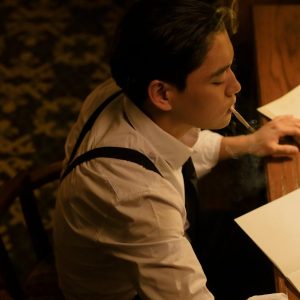
Hurbestone the Magnificent
"Ahh," said Hurbestone, and stood as soon as he saw her. The gesture was old school, performed with the slightest bob of his head. "Please," he'd been waiting for some time, up in his studio. "I was worried," he told her, not afraid to admit. "Can I get you something? Coffee? A soda? Alright then, let me just close the door." On the walls were photographs of actors and models Hurbestone had worked with. The pictures were glossy head shots, all signed and framed. "It's not so glamorous," he joked about the perceptions of his job. "I make things do what you don't expect. It's easy really," he shrugged and came from behind the six foot cabinet he'd been adjusting, getting the mirrors angled and the hidden door to slide. "How are you then?" he asked. "Have you eaten?" He was sincerely interested, attentive and tender. "I'm glad you're here," he let her know, motioned to the cabinet and had her get inside. The trick failed and Hurbestone was relieved. In the time since Alison, just over a year, he'd become reclusive when not working, drank and dodged any suggestion of dating. The magic he was famous for—the floating fire ball, aces in envelopes and mystical cabinet—were standard fare, yet his deadpan delivery and self-effacing style endeared him to all. Rather than flail his arms and prance about, he relied on understatement, knew he was fortunate to carve out a career where other, more talented magicians, failed. Even as he made coins dance and two hundred pound men float, he never claimed to channel magic, but credited the secrets behind his sorcery to a matter of diligent study. Alison's dying changed all that. In those first months he struggled with his concentration, could not quite get his tricks to work. Audiences were sympathetic, cheered when he managed to make candles ignite across the stage and coins emerge in the most unexpected places. Eventually his rhythm improved. He put on his shows, taught his classes, drove and flew where his agent told him, retreating afterward with whiskey and ice and “Do Not Disturb” signs hung on his door. Female fans, friends and acquaintances remained undeterred, brought dinners in tupperware, music and candles and bottles of wine to his house. They spoke of Alison dismissively, laughed anxiously and insisted Hurbestone take them to movies, dancing and for drinks. He did what he could to avoid them, stayed downtown at his studio late, ate out before going home and left his phone for the machine to answer. Two months ago, he returned from a performance at Granderson Hall to find Janet Fryman parked outside. Janet was a stenographer, a full-figured girl who wore her dresses much too tight and had a habit of moving heel to toe at a pace which could only be described as prodigious. Hurbestone sighed, considered rushing into his house and locking the door, but Janet was already on him, a bundt cake and bottle of Smirnoff in her hands. In the kitchen, using Alison's silverware and plates, Janet cut two slices. Hurbestone thanked her politely, pointed at the clock, yawned and said, "I'm afraid it's getting late." Janet in turn tried kissing him, her strong arms asserting muscle, overpowering as she leaned closer. Hurbestone made an effort to hold her off, but she began to cry, said this was the second anniversary of her divorce and not once in all that time had she been properly serviced. "I understand," Hurbestone offered sympathy, added quickly, "I do have something for you." Out in the hall, a painting by a young Stephen Dile. The picture was purchased at an auction several years ago, was worth many times as much now, Dile having gone on to scandal, suicide and censor before a posthumous revival. Hurbestone took the painting down and handed it to Janet. "A gift," he said. "An offering," and walked her to the door. * Before she got sick, Alison was the executive director of the Yellow Moon Theater. Hurbestone met Alison at the end of the Yellow Moon's second season. They spoke casually at a post-performance party for Pinter's 'The Dumb Waiter." Two nights later, Alison called and invited Hurbestone to dinner. By then she'd done her homework, wanted to know about his magic. He saw himself in the green of her eyes and answered not quite shyly, "Sometimes I get lucky." * Once Janet was gone, he made a drink, went out and stood on the porch to clear his head. Nights were a struggle, the house a tortoise shell abandoned. He stared down at the tops of his shoes, studied the cracks in the bricks of the porch. The phone rang and he listened through the open door for the machine. Hasley Milford had already heard from Janet about the painting and wanted to know, "What does this mean, Henry?" He went upstairs to bed. In the morning he taught his seminar on Will Alma and the Art of Illusion, then returned to his studio for rehearsals and tutoring two students through private lessons. Teaching was something Hurbestone started years ago as a way to subsidize his income. The money was no longer needed but he continued to teach just the same. Earlier that summer he took on a stand-up comic looking to add sleight-of-hand to his act, and an unemployed actress named Keena Wilson. Keena wore jeans and a blue button down shirt, her features framed by turns and edges. That first afternoon he taught her the pouring milk into a paper cone trick. "Funny papers," Keena laughed. In perpetual chatter, she asked him questions, talked about herself, rattled off her resume, mentioned the boyfriend she lived with, listed the recent auditions she went on, named each of her siblings, her parents divorced and scattered, her bills paid by nanny jobs and waiting tables. Hurbestone nodded as if this accumulated knowledge was meant to add up to something. He calculated her age at no more than mid-twenties, half as old as he was then and what a time as he remembered. * After Janet and Hasley Milford, other women came to see what Hurbestone had to offer. Ellen Kerne waited on his porch, skipped over and slipped her arm through his, said "Hello, Henry," and tugged at him to open the door. In the hallway, she surveyed the rooms, mentioned Janet, asked "What's she got?" and laughed. Hurbestone hung back. Ellen tried to kiss him. "If I have to, Henry," she took further inventory, reminded him of all her many efforts, the dinners made and delivered, the flash of thigh and sight of tit. "As long as we're being candid here, Henry," she put hands on hips, demanded he take her seriously. He gave her the silver tea set from the sideboard and she went away pleased. More women arrived in mini-vans and rented U-hauls to empty his house. For three weeks they carted away his china, his dining room table, his chairs and dresser, bombé chest and cheval mirror. He said nothing, sat on the steps outside and let them take it all. When Keena came to his studio for lessons, she asked, "How goes things with the vultures?" He'd told her what had happened, her open jabber breaking down his resistance. "They have everything now," he said. "There's nothing left." "Just you, Henry," she rolled coins between her fingers as he taught her. "I want to see." "But there's nothing." "Humor me, Hurbestone," she brought him a pen and piece of paper, had him write down the address. He spent the afternoon in the city, discussing plans for a new mass market magic kit that was to bear his name. Keena came to the house just before nine, found him sitting on his front porch. "Give me a hand," she called from her car. The backseat was packed with lawn chairs. Hurbestone put down his drink, opened the car door and took out the first of three green and white vinyl strapped seats. "A little house warming, round two," she touched his elbow. They set up the chairs in the front room where Keena warned him to, "Bolt the doors against the vultures this time, alright Henry?" He watched her go back to the car and carry up a large black duffle. "My stuff," she said. "Boyfriend troubles. It's no big deal." "I'm sorry to hear." "Do you mind if I crash?" "Where?" He hadn't expected, looked differently at the lawn chairs. "You can't mean. I don't see how," he held up his hands. "There's really no place to sleep." "I'll be fine," she opened her duffle and pulled out an inflatable air mattress. "Yes, but," Hurbestone cleared his throat. "I still don't think it's a good idea. Don't you have friends?" "Aren't we friends, Henry?" "That's not what I meant." "I can't stay with them," she explained how those closest to her would monitor her breakup, offer advice, make introductions until, "Eventually some guy will come on to me, or I'll get restless and sleep with someone and from there it's back to where I started. Anyway," she shrugged, gave summary, said "If it's ok." "But," he shook his head, not yet convinced she was serious. "I live alone," he told her. "I know that," she stood over her duffle. Hurbestone glanced around for something to offer, went finally and brought sheets from the linen closet, left them on the air mattress Keena inflated, stared off between the lawn chairs in the front room and said, "Good night." * Once, travelling with Alison on a working vacation, Hurbestone was asked in an interview to list magicians who'd influenced him. He mentioned Dagmar, Nicholas Stone, Slydini and Dante the Great. He'd recently read about the magician Dedi who, 5,000 years ago, amazed King Cheops by cutting off and restoring the heads of a goose, pelican and ox. Hurbestone said about Dedi and repairing things lost, "If I could do any one trick, that would be it." Laying in bed, he remembered the night he proposed to Alison, how he said, "The truth about magic is there is no truth. Everything is faith." He showed her tricks with his hands, made his fingers dance and her body move in ways that left her feeling electric. That night he slept and woke through a series of odd dreams, the sense of Keena below making him restless. When he came into the kitchen she was already up and drinking coffee, her green night shirt hanging loose from her shoulders, the top of her collarbone exposed. "Morning," she asked if he was hungry, offered to make eggs. "Thanks no, but go ahead if you want." He stood at the counter, having pulled on a pair of slacks. His hair uncombed, he used a sleepy motion to brush the loose strands back. Keena found bread, slipped two slices into the toaster. The butter was in a clear glass dish. She waited until the bread had browned, then asked, "Did you used to eat breakfast?" The question caught him unprepared, came so matter of fact that he answered as a reflex, told her, "I ate with my wife." "Alison." "That's right," he brought a butter knife from the drawer, set it on the counter. "We'd sit there," he pointed to where the table had been, held out his hand to what was missing. Keena stared for a moment, followed his arm down to the end of his fingers, extended her own hand out, said "I see," and slipped him a piece of toast. He went to shower and dress, drove to his studio and rehearsed his act. That afternoon he made an appearance at Page Turners, signed copies of his new book: The 10 Essential Elements To Making Magic. Around seven he went home and fixed a drink. Keena came and sat with him outside where they talked. She told him about her day, asked about his. The evening passed. He slept much better than the night before. The next morning he got up early and cooked eggs. Keena ate standing at the counter, found jelly for the toast. More days went by the same. Hurbestone grew used to her company, bought a bed for the spare room the vultures emptied and had Keena stop sleeping on the floor. The topic of her tenancy came up and he dismissed the idea of charging rent, then agreed to a minor sum. "We'll draft a lease, make it all legally binding." Twice she brought him lunch at his studio and twice he took her to dinner. Phone calls came from Keena's old boyfriend. She agreed to meet him, returned upset, said "Show us a trick." Hurbestone, already prepared, flicked his hand and produced flowers. The following week he had three shows in Jersey and phoned her each night. He admitted a certain paternal affection, told himself he did not mind the hum of his heart going soft. "If this is all that's left of you, old man." On stage, he performed his most famous tricks, drew "oohs" and "aahs" from the audience as he made ropes dance and silver dollars vanish. Before each illusion, he explained to the audience what he planned to pull off, then repeated the line he was most famous for, "Wouldn't that be something?" He flew home Sunday, on the first available flight, and Keena picked him up at the airport. * Each Tuesday for the last several weeks, Hurbestone drove to the Yellow Moon where he met with Karin Gowlen about the Black Orchid Ball. The B.O.B. was an end of summer fundraiser for the Theater. Karin was on the Board, had volunteered to oversee the first B.O.B. without Alison. "How are you, Henry?" she had the sort of voice that rolled gently like water, unfolding itself, her face round with light, modest lips, her eyes a soft jay blue. Hurbestone went home, made a drink and sat outside. Keena showed up around nine, dropped down beside him on the steps. "Apple?" she brought fruit, went inside for a knife, came back and asked, "How was your day?" He told her about his meeting and Keena said, "You should ask her out." "Who?" "Karin. She sounds nice." "Yes, well, I don't date," he had a deck of cards with him and practiced a trick with aces. Keena cut oranges, offered him a slice. "You should ask her anyway," she took an orange rind and put it across her teeth, smiled, then pushed the rind back out with her tongue. "At least think about it." She said, "It's been a long time, Henry. What if I made a dinner? We'll invite Karin and you can talk about B.O.B. That way you don't have to think of it as a date." The moon was half hidden, half full, the sky at dusk just dark enough. The night Alison died, a white moon shined through the hospital window. Hurbestone had gone and closed the blinds, convinced the glow was all wrong, but then everything became too dark and he didn't know what to do. He looked out across the lawn, could feel the house behind him, remembered the first night he came home from the hospital, after sleeping for a week on a small white cot in Alison's room. The house had seemed enormous then, as if the spaces between the walls had swollen while he was gone. He couldn't go into their bedroom for several days, had slept downstairs, worn the same clothes until the fourth night when he got very drunk and crawled up to bed on his knees. Sitting there, on the steps outside, Hurbestone stuffed the cards into his pocket. He thought of what Keena said about Karin, considered the pull and tug, how hard he tried to hold on while gravity pushed at him to let go. All of everything was this, the twist of a trick, the anticipation of producing magic against the constant risk of falling short. How ridiculous it was to love so much. Hurbestone resented the need still left, like some lingering hunger after a feast. When he leaned in to kiss her, so slow it seemed at first he wasn't really approaching her at all, she allowed him, briefly, eyes open, giving him the chance to understand before she backed off. He raised his hands, his fingers knowing, his eyes apologizing, a stuttering, "Sorry." He reached for his drink which was there on the landing, said again, "Truly," got up and went into the house. * In 1982, the magicians Jonathan and Charlotte Pendragon performed Houdini's famous Metamorphosis trick. Jonathan was tied in a sack and locked inside a trunk. Charlotte stood on top, lifted and lowered a sheet. A second later, Jonathan appeared where his wife had been while Charlotte morphed inside the trunk. From the time Alison got sick, Hurbestone had wanted to do this trick, had looked for ways to change places. The basement stairs were behind the rear door in the kitchen, the air below heavy as chalk and musty cool. Hurbestone refilled his glass, went downstairs, turned on the single bulb in the ceiling and walked to where the large brown boxes were stacked in the far corner. Each box was filled with Alison's clothes, her shirts and slacks and dresses which, until recently, had remained upstairs. A collection of old books and props from the early days of Hurbestone the Magnificent were stored on shelves and in trunks across the room. To the left, a cabinet used years ago, dusty now, large as a phone booth, the gold and red paint flaked, the door missing its latch. Hurbestone pulled a low stool over, went and sat inside the cabinet, folded his legs and closed the door. The heat inside made him sweat. He held the door tight against the missing lock, barred the light from coming through the crack. The first time he included the cabinet in his act, his ability to make people from the audience disappear drew wild applause. How did he do it? "People come and go," he used to joke. Keena stayed out on the porch, watched Hurbestone at the end of the hall go into the basement. She gave him time, ten minutes, then went and stood at the top of the stairs, listened, called "Henry?" before walking down. Last year, while practicing a new illusion, Jonathan Pendragon was struck in the heart by an arrow. The blow nearly killed him, though muscle protected him and he survived. Hurbestone tugged the door tighter. Outside the box, Keena sat not three feet away. She pictured Henry's face as it was when he leaned in to kiss her, his eyes enormous, his skin and hair, his scent, the dark and light, as close as her own skin. She said his name, knew he wasn't really trying to kiss her, not her as it seemed. Even before he did, she understood and repeated, "It's ok, Henry. It's all good." Inside, Hurbestone shifted in the dark, patted his chest with his free hand. What a mess now. How could he explain? Before he kissed Keena, he'd thought of Karin at the Yellow Moon. He remembered tricks he learned from other magicians, the way Alison in the mornings would get up while he was in the shower, timing their breakfast for when he was done dressing; a bit of magic better than anything he ever performed. He closed his eyes and waited. Karin had brown hair. She had soft arms tanned and bared in sleeveless tops, a reedy symmetry. Her voice as she asked him, "How are you, Henry?" touched high chords. He considered opening the door, sliding over and making room on the stool for Keena to sit beside him. He imagined her putting her head on his shoulder and how he would hold her hand tight, talk of the dinner they'd make tomorrow, the food they'd serve and things they'd say to their guest. What a funny story they'd have to tell about tonight, how everything converged so unexpectedly, the mystery of it all, what came little by little, the longing slow to change, in the briefest measures before release. He smiled to think. How delicately we love. Like magic, yes. Like Dedi the magician, severing and repairing. Keena outside the box, saying "Henry? Henry are you there?"
Steven Gillis is the author of the novels Walter Falls and The Weight of Nothing, both finalists for the Independent Publishers Book of the Year and ForeWord Magazine Book of the Year 2003 and 2005, and the short story collection Giraffes. Steve's third novel, Temporary People, was published by Black Lawrence Press in April, 2008. An eight-time Pushcart notable, Steve is a member of the Ann Arbor Book Festival Board of Directors, and a finalist for the 2007 Ann Arbor News Citizen of the Year. Steve teaches writing at Eastern Michigan University and is the founder of 826 Michigan—www.826michigan.org—and the co-founder of Dzanc Books—www.dzancbooks.org .
© 2008 prickofthespindle.com |
||
|