back to homepage
back to fiction
   
© 2010 N. God Savage, " The Waterfall"

A Companion to Minnow Lake
By Heather Fowler

For Ann and Doug Bailey


Cecil sat on the train wearing his charcoal business suit, variegated socks, and his splendid silk tie with small green stripes, but the outfit was stuffy, he decided, and reminded him of his years practicing law. He hadn't worn this suit in twenty some odd years. The last time he wore it was to a church luncheon, and truthfully, he avoided those whenever possible, but his daughter Camille had made him go.

She was the wrong type of Christian, he thought, the type who had an urge to convert or reform every person they met, the kind of Christian who would joyfully lead a crusade—at least, she had been ten years ago when last they’d visited at length, but Cecil vigorously believed in the phrase "live and let live." In fact, because so many early decisions had been made for him during the course of his life, now, when he was old, he felt perversely glad to ignore any convention. He hadn't been to church since he was fifty. He stopped practicing law at fifty-five because he hated it, hadn't decided to be a lawyer in the first place. His mother had decided it for him because his father had been a lawman, and, in her words, a son should follow a father’s lead.

"Father" was the term Cecil used to describe him in conversation, but privately, he referred to his father as Papa. Father, as a term of address, seemed so cold. Though he wanted to call him Papa aloud, he kept it a personal prize, his mother having intoned the words "your father" in so many of her tirades that Cecil’s memories of Papa, as Cecil remembered him, were guarded and stored. He was never sure when their magical power over him would be used up. How did his father bear his mother?

Sometimes, when the day was there for whiling away, Cecil considered his father’s ever-present duality in his life, as though the same person had two identities—the cherished Papa in Cecil's head, and his mother’s daunting "your father," imbued by her with cold and ruthless strength. The two could not be reconciled.

Cecil looked out the window where the train passed an undeveloped lot of clay-colored land. There was no change of scenery from his window for several moments until a small green sign attached to a faded Ivory Soap billboard heralded impending arrival at Camille’s town: Valley View, 10 miles.

Camille said Valley View couldn't be longer than ten miles running, so Cecil supposed it would be like Crescentville, his father's hometown. His father, known as Greggo to his friends, died at forty-five from a stroke after years of stressful living. His passion for the law, too much red meat, too many cigars, and too little sleep had fastened the noose. Cecil supposed, when thinking of their shared career, that he himself had lived so long because he ran his practice deftly, without sentiment. He toiled for his practice to succeed, despite his disenchantment, but had worked long hours to retire early.

Despite the success of his practice, even working hard, Cecil could never do enough to please his mother. When he was in his early forties, he took Emily to his mother's house on Sundays. It seemed, at times, that the old woman was holding up some switching ruler of his youth in contrast with his productivity, as if to say he had done nothing, and constantly measured him against his father's achievements, though he could never better them. “Your father was twice the man that you are,” she liked to announce. “Bless his soul.”

Once the dead had died, they were her saints, Cecil knew. At one time, Emily sat with them, still as a locked doorknob, but when they got home, she questioned him in her sweet way about why he let his mother treat him so cruelly. After a while, she pleaded sickness from these outings and stopped coming altogether, because Cecil's mother had a ritual of frigid degradation. First, she repeated the number of clients his father went through per week. Then, she repeated how prestigious it was to be a lawyer—and, finally, she re-emphasized, though in other terms, her triumphant litany of persuasion regarding how, after Cecil graduated with a Bachelor's in Psychology, she had pushed him into law school and out of the Psych Doctorate program at NYU. She then rode him, goaded him, and shamed him into his law degree, which was, to him, merely a piece of paper on the wall.

His father died with a legacy of insurmountable greatness, but Cecil’s peculiar failures in her eyes had always been thus. Although Cecil had tried to love her, the gifts she gave him as a child were strictly necessary items: compasses, rulers, erasers, books, and thumbtacks. The gifts he gave her she never understood. These were the formative moments he would later discuss with Emily, long into the nights, ever stuck on the plangent details of his mother’s misplaced affection.

Once he brought his mother a bouquet of daisies. The next day they were in the trash, and the green ribbon tied around them was soiled in carrots and rotten chickpeas. Once, he painted her a picture. She gave it to his brother Jude to color on the backside. Jude was four then; Cecil was seven. Cecil never forgave her for letting Jude maul the work because Jude didn't color on the blank side; he colored over Cecil's airplane. Jude had been mother's favorite. Mother pinned the airplane up on the refrigerator with Jude's ugly yellow and purple crayon, saying, "Look at what my two boys made for me!” and patted Jude on the head. Even now, at seventy-three, Cecil felt persistently shamed that his picture for her had been seen only as the background image on her refrigerator door, while Jude’s had consumed the limelight.

When Jude died in a boating accident during the family vacation to Carolina Springs, Cecil was nine. He remembered standing in his brown funeral suit with a pink carnation tucked in the lapel, holding his mother's purse. The rain pelted the pastor's slick hair and rolled off like hot oil. Jude was only six. He looked like a dead cherub, morbidly made up with blusher. Into his open casket, Mother poured herself, bawling and bawling, until she made no sound other than a rasping choke. Her make-up ran down her face. She reached for her brown leather purse behind her once, but didn't look at Cecil.

Only his papa clenched his hand with any warmth, working six days a week but arriving for the one-hour service before returning to his office. Afterwards, Cecil had a toothache, and mother wouldn't take him to the dentist until three days later. He feared, privately, that she hated to look at him because she wished it were him instead of Jude who had passed.

Mother initiated the move to the city after his father died. She sold his father's house for a "good deal of money," but Cecil's Papa would never have moved. His house in the country had been intended as Cecil’s inheritance. The lake was to have been his lake. Both house and lake had stayed in his Papa’s family for over a hundred years, and because his mother had sold it, Cecil decided in the instant that she did so, that his mother had never truly loved his father.

Though it was rare for his father to take time away from his overworked life, on the few weekends Papa had taken off from work, he'd spent his days sitting beside the lake, very still. His mother had no taste for it, busy as she was intervening in other people’s personal business, so his father often sat alone, and Cecil watched him, hidden, crouched in the wheat grass on the periphery. Long tufts of smoke rose from his Papa’s mouth, and Cecil was quiet as held breath, quiet as a leaf.

Cecil’s father had stocked the lake with bass every year, and fished with his son during the summer. The trips started when Cecil was nine, just after Jude died. The first time they went fishing, his father baited the hook, saying, "Watch me once son. From now on, you'll bait your own." And then he smoked. Cecil's father loved Cuban cigars, and for some reason, much of the time, Cecil's mother.

Cecil's train ride now was a jumble of memories. He found that the older he got, the more he remembered about his childhood. Perhaps it was the knowledge that he was moving to the country that brought up such nostalgia, but it had been years since he thought about these things with anything more than a sad shrug. He did miss Emily today. She had been forty-two when she died, and Cecil had never remarried. She died driving home one icy night, her car spinning over a cliff, rolling and catching fire. The car was junked; he didn't want to see it.

Jude. Papa. Emily. Mother. All family dead, except his daughter Camille.

As a man, Cecil had been to more funerals than weddings in his lifetime. He thought of his days and times as many dark spots with a few bright dahlias. It was his mother’s eventual death, a follow-up to Emily’s, that led him to early retirement. With his parents’ money, and nearly half of his paychecks saved from the last fifteen years, he was finally free to quit his practice. But for whom would he live now, if not for himself?

He didn’t want to attend church with Camille. He would refuse, maybe lounge about her property’s lake. When Emily was alive, he spent a lot of time wondering about his father's sold retreat. Who currently owned it? Was the lake still stocked? Did anyone fish there? He visited once and tried to buy it, just after his retirement, but it had gone ramshackle. A young girl lived there with a few friends. The house had become a commune.

He asked her if she’d be in the market to sell anytime soon. The girl nodded no, her dirty long hair spinning from her head, and she shut the door. He went back again soon thereafter and offered her a substantial bit of money, but sadly gave up the notion of purchase when she firmly told him she wouldn't sell her house to a lawyer, which he was then. “I need to buy this house,” he said. “It’s the only thing I can have of my P—” He had to stop, several times, due to being choked up. “My father owned this house,” he then repeated. “I want it back in the family. My mother sold it. I would not have sold it. It matters to me.”

“Well, I like it too,” she said. “And I paid good money for it. And I don’t want to move.”

“But I’m offering you double the would-be asking price,” he said.

“You could offer triple and I’d still say no,” she replied. “I’m sorry.” Her pupils were dilated and he watched her stare at the crack in the doorjamb, her feet pointed apart like a ballerina.

Camille and Emily sat in the car waiting. He could see their expectant faces watching, distantly, through the car windows. "It's an ugly house anyway, Dad." Camille said. "All boarded up and rotting. Who wants that place?"

Emily looked back warningly. “Don’t worry, dear,” she told him.

Inside, Cecil damned his mother again, and rubbed his forehead while he drove away. Later that day, he took another drive by the lake and parked by the road to observe it; the girl with the stringy brown hair was floating nude on its surface. She was pale in the five o' clock light, and looked like Ophelia, poor mad Ophelia without a heavy gown, with small and nearly flat breasts, with a slight smile that was neither happy nor distraught.

He watched her for a long time, not desiring her, just watching. When she turned and swam to the lake's edge her young shoulders rippled beautifully with motion. Her face was clean and elegant devoid of make-up, timeless. It might have been 1813, or 1613 for that matter.

This was the last time Cecil saw that lake—the last memory attached. That night, he’d returned to his hotel room and ordered a scotch and soda, and Camille, only six then, had cautioned him against too many. “Daddy, you need to stop, Daddy.” Even now, he feared he had failed her as a father. She was undisciplined, self-possessed, cruel, and vulgar in her demands, reminding him painfully of his mother, refusing to listen to any but the most practical of details. When he was dressed slovenly, she didn't listen to him at all.

Though en route to her home now, the suit he wore for the train was his way of setting the rules of conduct. First, he didn't need to be babied. Second, she would not open his mail. Third, he would leave the house when he willed, and fourth, he did not need crafts. Cecil was adamant on these issues, but he wasn't sure how his prim daughter would react. Perhaps there would be an unpleasant scene, and she would wear him down until he settled into acquiescence. He couldn't remember a conversation with Camille that had ended happily. In this, too, she was like his mother.

It had been many years since his mother died. She'd outlasted Emily by four years, and he often thought about her, not because he loved her; not because he missed her, but because either Camille brought her memory back to him on a visceral level, or because he felt neither of those emotions—only a sense of overwhelming relief.

He remembered her funeral, which was sparsely attended. It was windy. As if through the oscillations of a ceiling fan, the pastor's eulogy was scattered to the wind as though it were being deployed by a gramophone on low volume, and he heard the holy words...walk through...valley... death...shepherd...pretending to agree...sainted soul...lovely woman…and nodding somberly at each rise in inflection.

Then Camille had been twenty-five, but that was twenty three years ago. Now, Cecil looked again out the window and searched for Camille on the platform; whistles moaned, and the train stopped; Camille would probably be late. Even in a crowd, he expected he would find her easily; Camille was distinctive with her thin eyebrows and wide eyes. She didn't take after Emily, and got none of Cecil's good features, but was the rare kind of woman whose face assumes no age: eighteen, going on forty, or forty and virtually unaltered—blending in.

Her hair had never wavered from its original mousy brown, and her skin assumed a stretched, hanging look. When she smiled it was melancholic, and her teeth were slightly crooked. He had offered to buy her braces years ago, but she didn't want them, and Camille had a sharp tongue, like sour crab-apples; Cecil suspected this was the reason she had never married.

Though one in death and one in flight, Emily and Camille had left him at virtually the same time all those years ago. After Emily died, Camille drifted away to Norfolk with her boyfriend, Tom. The relationship didn't last long. Tom had been the cheating kind—but that was years ago, Cecil knew, and possibly many men ago.

Today, Cecil was moving in with Camille, away from his apartment in Greensborough next door to his fishing buddy Doug. Cecil’s doctor had prescribed a few months in the country after his apartment had been robbed and vandalized; this incident was soon followed by an acute heart attack.

If it weren't for the heart-attack, he would have continued, as per usual, to see Camille at Christmas and holidays, but unexpectedly, en route to her new house, he found that he felt surprisingly good. Camille had tried to put him in a home after the incident, but couldn’t afford the care, so instead reluctantly offered her own. Getting off the train, he pulled his bags from the overhead compartment and waited for his others, feeling a tremor of anxiety before reminding himself he was not going to Camille's old apartment, which he would not have moved to for all the stars in North Carolina. That apartment stank of mold, and there was no elevator. Its rooms were sparse and ugly, and Cecil had visited only once.

Due to new employment, Camille had recently resettled in Valley View. Her new place was a red-brick colonial with white porches—three stories high, she'd said—and only three hundred and twenty five dollars a month. She’d written once to send him pictures. On the property there was a lake. She sent no pictures of the lake, but her omission of details whet his appetite more than a glowing description would have. Perhaps this would be his calming place. The lake decided matters, and he’d moved quickly to ready himself within two weeks.

He vaguely remembered selling his furniture last week to the same family he sold his apartment to. The property had appreciated quickly as the years went by. He offered it at a decent price, which he sweetened even more when he saw how pleased the family was with his little place and the bickering that went on between the petite wife and her husband. "We can't afford it," she was saying, and the children hid under the coffee table playing slap games, so Cecil dropped the price by five thousand, thinking they needed a break while just starting out. The furniture he almost gave away, but a few things he kept: a curio, a roll top desk, a blown glass lamp, and his mother's china. He signed all the papers, and the escrow would close shortly; until then, they would send monthly rent checks to Camille's address.

His bank account was still plump, getting plumper all the time, and the only thing he bought himself for the move were several boxes of fine cigars to support the new habit he intended on starting. He rented a storage area behind the complex from the Hide-Away lady Ann and liked storing his things as if temporarily, as though he was to go on a long semi-permanent vacation like a man of leisure.

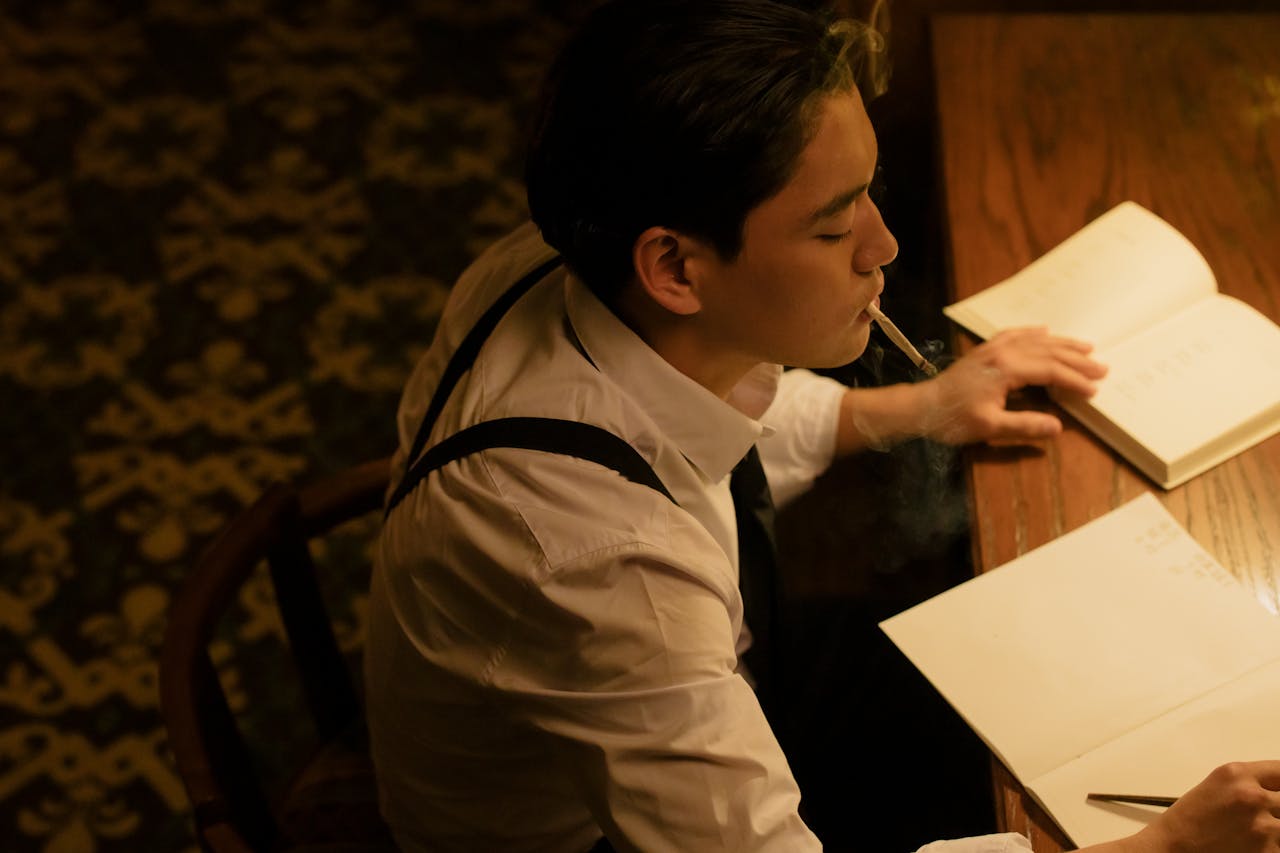
He tried to picture the lake like the one on his Papa's land. With the luggage matter quickly resolved, he sat on the wood bench awaiting Camille, smoking one of his genuine Cuban cigars. Cecil tasted the fragrant smoke, and felt as he did while kneeling beside his father. The odor was familiar, if not identical. He rather felt like his father today, and hoped to spend a few weeks by Camille’s lake, re-enacting those quiet times. The first few puffs of the cigar were strong, and he coughed smoke through his nose.

A lady with a poodle snorted at him from the bench nearest his seat. He poo-pooed her, waving in a friendly way, and considered her smile in reply a good omen. He was tempted to put his thumb on his nose and wave his fingers around like a child. He smirked, waiting for Camille, and passed the time with a shoeshine from the white-aproned young man as another extravagant treat. These fancy shoes wouldn't leave his closet for at least another five years after today.

Cecil felt faint with pleasure. His mouth began to tire of so much smiling. A minor rush of blood seeped to his head from the cigar. He decided to smoke at least two cigars a day. His doctor might be angry, but he didn't care. He went over the rights list he would give Camille so as not to forget, then Cecil, pleased and dizzy with smoke, regarded the crowd. A passel of children came out of the train to nestle in the warm breasts of their mothers, who chirped and twittered over them. A few lone businessmen walked briskly toward the exit. Occasionally, he caught a glimpse of a tottering older person and smiled. Old travelers were his favorite.

This morning he’d combed his fine white hair in a part down the center, and he had the feeling of being off on an expedition. An expedition to a lake—what better? If he liked it well enough, he just might stay. Truth be told, he had long desired a move, and knew from Camille’s letters that she had more than enough room. Besides, he'd sold the apartment, and where else would he go? He would tell her this in a week or two. For now, he'd try not to scare her with being saddled with her old dad.

Cecil checked his pocket watch and noted that she was half an hour late. He began to feel a slight head-ache, accompanied by a growing impatience. Finally, one hour after his train came in, Camille arrived. He was the only person left on the station bench.

"I'm sorry I'm late, Da," she said. "Traffic was a mess." She pecked him on the cheek, and helped his bags into her Volvo. They chatted as they approached the house. The first thing he noticed from her driveway was the lake she’d described. It was about an acre long, and green in a limpid way. One end was kidney-shaped, the other round. Yellow flowers laced its edge.

Her tires rolled over the gravel and they seemed to be taking him past the lake in a panoramic view where he could see each angle, every side. Dragonflies, water-bugs, and flies flew over the top. Cecil clenched his palms. "Is that a freshwater?" he asked.

"Yes, Da," Camille said. "Water from Shanty Creek comes up through a pipe in the bottom." Cecil noted a few willow branches that had fallen into the shallow end and decided to pull them out tomorrow. He made a mental note to remember to write Ann, to tell her to please send his fishing pole, because he had forgotten it in Greensborough; he'd intended to pull it from the rented storage cabinet, but, in the rush and hustle, had gone to the station without it. He remembered the exact place he'd left it, at the front of the storage room where Ann would have no trouble retrieving it. It was late spring, and if she were conscientious, he could have it by early summer. When they arrived at the house, Cecil settled his few belongings in the room and strolled out to the long white porch that surrounded the second floor of the house.

Camille had made tea, and he sipped this on this porch, casually ruminating on the lake’s color. Mostly green, he thought, with patches of blue where the sky hits.

“Pretty day,” he said.

“Hmmmph,” Camille replied.

Around the lake was a wood stump and barbed wire fence. The gate to this area was locked, but a grazing pasture came right up to it, although he’d yet to see any cows.

“They’re in the far pasture,” Camille said, as if reading his mind. Squinting, Cecil saw them in the distance like tiny brown specks. "You should rest now, Da," Camille said. "You've had a long day. Take a nap."

Cecil did not want a nap. "Are you renting this place, Camille?" he asked.

"Of course."

"I am going to buy it tomorrow," he said. "Call your lawyers."

"I haven't any lawyers."

"No matter," Cecil said. "No matter." He looked at the lake again and wanted to own it with increasing ferocity. It seemed to glow with a new hue. Light nibbled at the surface, which scattered sunlight in circular patterns of moss green, white, agate, and sepia, swirling with spun reflections of the willows and sky. There were no other trees but willows around the edge, those weeping tentacles sweeping down and caressing the lake’s surface. Cecil was tempted to sit there and smoke another cigar, finding it very peaceful, but Camille bothered him with endless chit-chat until, yawning, he went to his room. She followed him and found his cigars, taking them with her to the kitchen and telling him he could have only two per week, due to his heart attack.

He sat up in bed for a long time, muttering to himself. Camille found him the next day sitting by the window looking out at the lake and pulled him away, detailing small tasks he could do to keep occupied. "Don't look at that lake so much, Da,” she said, worrying a small piece of a cream doily on a table. “They say it's haunted, and people have died there, so no one goes near it."

"Ridiculous," Cecil said, still angry about the cigars. He penned a quick note to Ann about the fishing pole and sent her the money for the postage.

Though he found the lake tempting, Camille led him this way and that on errands, so that his first few days were filled with sightseeing and visits to her friends’ homes. He took a trip to the local library and researched the lake, then read in old newspapers that the property had changed hands six times in the last twelve years. Set on his path of buying the house, he called to inquire who owned the house and the land, but found that both were owned by the bank. Evidently, after dropping the price below market value for the land itself, the last owner still hadn’t found a buyer. The big bank Crestar finally bought it. They’d planned to sell it to a tourist for a good profit, and Camille was in no position to buy, but instead of letting it sit in this rural place with few new buyers, and because it had already been a year on the market without a prospective purchase, they let her rent it for a small fee, with the provision that if they found a buyer, she would have to move out with little to no notice.

The bank manager told him all this over the phone, and Cecil went to the bank the same day to make his offer. They accepted immediately, asking if they should notify Camille that she should move out. Cecil blushed at how long it took him to say no. And besides, this haunting business about the lake was ridiculous. Cecil felt he had made an excellent deal.

The people who died in the lake were young and old, wealthy and poor, but mostly tourists. He suspected that they came from a backwards place like California where they hadn't many lakes. Poor swimmers, he'd concluded. Death by drowning was the cause of death that all the newspaper clippings listed—as if that explained everything.

He watched the water whenever he could. Cecil was an early riser from his years at the firm, and normally rose at six in the morning from force of habit, but lately, since moving to Camille's, though he took several cat-naps during the day and went to bed at 9 p.m., he still wasn't sleeping well. Camille guarded him zealously in his first few weeks and kept him too housebound to roam. “You need to rest more now, Da,” Camille often said. “At least several hours a day. Can’t go gallivanting into the wilderness now. Give yourself a chance to recover.”

But the days passed quickly, one into the next. When he’d slipped free to visit the lake one lazy afternoon, he found the gate was locked. Occasionally he experienced bouts of insomnia that left him staring through the big kitchen windows at all hours of the night wishing something unusual would happen to lend him some perspective on the last directions his life might take.

One such bout of insomnia found him sitting at the window in the middle of the night in mid-August, when young summer had all but died as the grasses browned in the neighborhood and the annuals stopped flowering in the beds. A flurry of activity at the lake's edge triggered the floodlights and caught a woman in a pale blue dress sprinkling flowers over the lake. She regarded him, trapped in the bright halogen directed at her, then walked hurriedly through the adjacent pasture and out of his sight. Cecil set his alarm the next morning for just before four, the same time he had first encountered the woman in the blue dress, and tip-toed to the kitchen to see if she returned. She had, and each morning she brought more clover. He noticed that a good portion of the lake was coated by green. Each morning, he turned on the light inside the kitchen when he saw her trudge up, and they began to relate to one another through slight waves and gestures. If he turned the light on, she knew he was watching. If she gestured back to him, he knew she wanted him to see her. For several days, Cecil followed her progress carefully.

On the sixth morning, she sat by the lake, cross-legged like a child, until nearly seven. It seemed she was waiting for him. When she stood to walk away, he fled the house to discreetly follow her, maintaining a fair distance between them, as if out for a clear morning walk. Her ritual intrigued him, but when he arrived at her house, he was disappointed to see that it was nothing more than an old peach and green Victorian in a perfectly normal neighborhood, where children played in the street and cats ran into and out of the manicured shrubs.

He passed her window and saw her pale face staring out at him, but then her body turned, and she pulled the curtain around her back as though to block the view of him from whomever she had been talking to. When she turned to close the curtains, she mouthed "Go away," and retreated behind the veil.

Cecil could not fathom why she acted so strangely, but then he was a stranger who had followed her home. But why, he asked himself, did she look at him so pityingly? He went away, feeling chagrined, and dismissed this as an old woman's need to be alone, but she did not come the next day, nor the next. She was either a mystic, or crazy, he decided. Cecil wanted no part of either.

When he had rounded the corner of the street that led toward his house he saw another older man with a dark green felt cap striding in his direction.

"Excuse me," Cecil said. "Have you lived here long?"

"All my life," the old man said.

"Do you know much of the topography?

"A fair amount," the old man said.

"There's an old man-made lake up near—"

"Minnow Lake," the old man interrupted. He took out a pipe and lighter from his coat pocket and set the flame to the tobacco. "There's nothing really to tell," the old gentleman said. "Several people drowned there, but they were lost souls anyway. Anyone with a firm head needn't worry about it. There's nothing in there now but fish, mostly minnows and brown eels. You can fish there if you don't mind fishing in a grave," the man added.

"Thank you very much," Cecil replied, thinking the old man was just as strange as the woman. His idea of Valley View as a retirement community was beginning to shift. Cecil turned to go, tipping his hat in what he hoped was a cordial way.

"See you later then, Cecil," the old man said, also turning to go.

"Hallo! How did you know my name?"

"Everyone knows you're Camille's father down from the city," the man said. "We're a small town, Valley View." On that, he smiled and turned on his heel before walking up the next bend, leaving Cecil standing with his white fisherman's cap in hand, in the middle of the empty road.

"So, what kind of fish are in that lake?" Cecil asked Camille later in the day, watching the ripples and puckers.

"Trout and bass," she said, chopping at raw chicken in the flour on her cutting board. "An occasional bluegill, minnows, and a few eel."

"Have you swum there?" he asked.

"Oh no," she said. "It's far too murky." She asked him about weeding the garden, and mulching where the small tomatoes grew before muttering, "You'd do well to stay away from there, Da. I mean it."

“I bought this house for us, Camille,” he replied. “Did I mention that?” They spoke awhile of that transaction, and Camille looked at him with pleasure in her eyes, touched that he was willing to share it with her. During this moment, he thought her unusually pretty. He didn't want the tight look to return to her face, so he avoided further mention of the lake.

The next day, while she was away on errands, he walked a quarter mile up the road to a small farm, and bought five milking goats. He lifted them over his head, goat legs kicking as he struggled with the height of the short fence, and the pull of the others tied to the rope, who strained to graze beyond the place where their mouths could reach. Goats are a stupid lot, he thought, but he knew he, too, must make a stupid sight—hefting goats over his head and dropping them into a cow pasture, but he wanted to prove to Camille that the superstitions she had regarding the lake were completely erroneous. As soon as he could find a tool to break open the gate lock, he would sit by it regularly, but for now his agenda was keep the goats alive and visible to prove to Camille that she was wrong about any perceived danger, so that when he went there to sit, she wouldn't baby-sit him.

Goats are ravenous beasts, Cecil reasoned, and the tender morsels of green around the lake's edge will be irresistible. The cows were pasture cows. Camille said they'd been there before she moved in, and perhaps they were trained to stay away from the lake; but Cecil's goats had never seen it before.

Goats are ornery. Goats are shameless. If goats will not eat around a lake, then nothing will, and conversely, if they will eat, as goats tend to do, then there was nothing odd about the lake. These goats were his experiment; if they nibbled at the tall grass at the water's edge without disappearing, this would disprove Camille's suspicion.

Many days passed without incident, until one day he saw the old, blind grey goat wander down to the edge and delicately eat. The others continued to graze on hay he’d thrown down near the fence. A few days later, the grey was missing, but he figured it had chewed through a distant gate or stayed far afield. Possibly it had been eaten by some other wild animal who had sneaked in through the gate. He investigated and saw no openings anywhere in the fence, but the field was long where they could roam, and perhaps what happened wasn’t visible to his naked eye. He took a stroll. It tired him to walk to the field’s edge, so his attention was somewhat thin by the end of his search.

"Camille," he asked over dinner. "Have you seen that grey goat?"

"Da," she said reprovingly. "Are you asking about Minnow Lake again? Don't forget that you're here to rest, and all you do, day in and day out, is stare and fret. Go on down there and sit nearby if you must. Go on down there and see. Maybe you’ll disappear just like that goat." Then she blanched. "That was horrible," she said. "I didn't mean it. Please forgive me."

Since he told her about buying the house, she seemed much nicer, and he wondered if perhaps he had been too hasty in assuming she was trying to confine him. "I am here to rest," he said, drawing himself up loftily, "But I am not so old as you think."

"You're old," she said. "You have flights of fancy—and a weak heart. Now more than ever. Stay away from it."

"I should go back to the city," he announced, not really meaning it.

"No Da, please don't leave," she said. As a tear fell down her cheek, he was pleased by this uncharacteristic softness. "You may look at that lake as often as you like," she said. "It's just a lake. Who am I to tell you no?”

She sat heavily in the crimson couch, letting her head fall in front of her. Cecil put his hand in her hair and patted her head, but early in the morning he walked down the path and came to the locked gate. He pounded the lock with a hammer from the back shed until it cracked and popped loose. He walked around the lake’s kidney-shaped end, where the willows were, and felt pleased for the first time in many weeks. He brought out one of his weekly cigars and puffed happily. The next day, he took the small, red wrought-iron patio set and delivered it to the embankment. "Ha!" he said. "Superstition be damned." Rising from his chair, he looked into the lake to see a small minnow zip by.

From her place at the window, Camille regarded him on a rare day off. "At least he is happy," she said. "The belligerent old crow." She took him to the doctor’s appointment he needed for his heart. His tests and visit went well, and after that, Camille encouraged him to go where he liked. Camille also permitted him one additional cigar per week, which pleased him to no end. Many days he spent musing about his past, dreaming of his Papa, and wondering, in the placid scenery, if he had been too hard on his mother. Maybe if he had known how to talk to her, if he had said the right things, she would have softened as Camille had recently. “You silly old sap,” he said to himself. “Maybe you just want to love and forgive everybody now.” And why not forgive, he thought? Why not? He had even begun to imagine how it might be to see Camille get married, choked up at the thought of walking her down the aisle, a forty-some year old bride, finding it harder and harder to believe that there wasn’t a man out there somewhere who would claim his aging, hard-shell daughter.

One late afternoon when the light trickled down with a pinkish hue over the willows and into the water, he felt stronger than he had in weeks, a burgeoning vitality that recalled his youth. He thought of Emily, how deeply she had admired his ability to hike, and how he missed her while walking around Minnow Lake. He thought of Jude, too, how he’d never given his drowned brother a chance. Reflecting upon this, he glanced over to see an unusual tremble in the water's surface. Two green-hued boys played beneath it, and the murky bottom had re-surfaced to reveal a green meadow texture. He could see their tow heads bob and fall as they ran across gaily, skipping and mouthing words to each other until they dropped below his vision near the deeper middle of the lake.

He ran to the house, shouting for Camille, but it was a Sunday and she had only recently returned from church . "What, Da?" she asked. "What?"

"Nothing," he said. "Never you mind."


Several days later, Cecil bent over the lake's surface, dirtying his cotton slacks to look at the lake-bottom again. He observed it so intently, in fact, that he realized he'd been watching a single minnow circling a reed at the bottom for more than five minutes, when suddenly, one little boy's face reappeared, staring up at him with fish-like eyes.

Cecil gaped. He brushed his fingertips over the water’s surface, reached down, and felt nothing. When he retrieved his hand, the surface ripples continued, but the boy’s face remained clear below them. He mouthed something underwater that looked like "Who are you?" His small mouth was crusted with sores, and his eyes were rimmed with red.

"I’m a companion to the lake," Cecil said, watching the same fish swim in circles around the boy's hair. Cecil felt an odd sensation through his forehead, and had the strange impression that the boy was causing it. The sensation was of a leather strap tightening around his temples.

"Don't you recognize me?" the boy asked. "It’s me, Jude." Cecil stared at the face and staggered back a few steps. The same morbid cherub stared up. In his hand, Cecil saw a twig from one of the willows above. Bruises and lacerations covered his face from the rocks he’d been buffeted against when he had died. “I’m a little hurt now,” Jude said.

Cecil started from the pond, his heart pounding, and ran to the house in a panic, leaning against the trellis wall and breathing heavily. "I am dreaming," he said, his nostrils full of the star jasmine that had not stopped blooming. "I must be dreaming." He awoke the next morning in bed with a slight headache. When Camille came in with two eggs and some toast, he said, "Thank God you're here. I had the strangest dream."

"Da, you need to relax," she said. "Especially after yesterday."

"What happened yesterday?" he asked, eyebrows twitching.

"I found you by the trellis," she said. "You had fainted and bumped your head. I had to ask the neighbor to carry you up here. You gave us quite a scare!"

Cecil heard a young voice calling his name, accompanied by the voice of a woman. "Who's here?" he asked, raising from the bedclothes in his rumpled shirt.

"Da, no one's here," Camille replied, irritable. "Or, me. I’m here! Your daughter Camille. Rest a while, and I'll make you some tea." She bustled out and finally he drifted off to sleep, still seeing the green little face floating in the lake.


Camille returned to visit just before evening. "The doctor is taking you off that new medication," she told him.

"What medication?" he asked.

"The one for your heart," she replied. "He called to say you must be having side effects and perhaps hallucinations. I gave you the last pill at eight this morning. I’ve been hiding them in your food."

"I’ve had hallucinations?"

"Well yes, it's quite common," she said. "But don't worry, Da. The medicine should lose its effect sometime day after tomorrow. I'm sorry I couldn't tell you. I knew if I did, you would refuse." She touched the gold cross at her neck.

Cecil was angry and relieved at once, but he didn't speak throughout dinner, and the next day, she announced she had to return to the office. She left him that morning with strict orders to sit and listen to the radio. "I have to go back to work sometime, Da,” she said. “Go and work in the garden, if you must, but nothing too stressful. I've got to go now, or I’ll lose this job." She pecked his face in her traditional way, but her hand lingered on his wrinkled cheek before she rushed out the door.

All day he heard the voices from the lake, and when he could no longer bear it, he strode down to the lake's edge, but nothing was there. Tricks of the mind, Cecil thought, but he remembered the face of the lake boy vividly, and that boy had been Jude, just as Cecil now remembered him from the day they drug his body up, lifeless and cold, when waves of river water had spilled from his mouth as his chest was pumped, but the rescuers still could not revive him. Cecil remembered watching Papa’s face break when they stopped trying. The long sad haul of the body to the morgue.

For a few days, he puttered around the house, beginning to feel quite lonely, but on Thursday of that week, Cecil considered fishing. His pole had long since arrived. Camille was out of town until Friday morning, so Cecil unwrapped the paper parcel and decided to see what he might catch.


He felt normal again and decided that the drug had caused those days of peculiarity. The lake was the same lake he had admired for countless hours before coming to sit beside it. Though his insomnia had dwindled, the new experience of seeing the boy’s face had created a minor resurgence of such and Cecil found, when he could not sleep due to the ticking of the clock, that he revisited the kitchen and again sought the woman he’d seen before in the blue dress. She did not disappoint. Clover. More clover she carried. He even noticed how she got into the area in the first place, which was not through the front gate. She approached from the far distant pasture where the cows had been. There were two wood poles without fencing between them. She shimmied between them with a sideways step. “And the grey goat must have left there, too,” he remarked.

That evening, the season reaching well into September, he walked out to watch the green willows sway and dip their branches, the green moss and familiar ripples dappling the water's surface. The light was falling to give way to the pleasant hour of twilight, that hour when the sky is not quite dark, and the moon shows prematurely. The moon tonight would be a blood moon, red as the sunset over a darkening ocean.

He had just baited the hook and cast a lovely arcing distance, when he noticed an unusual turbulence under the water fifty yards away. He reeled in the bait, propping the pole against a rock near the patio set, and ambled closer to explore. It couldn't be a current, because the water was piped in, and only came through the round ribbed pipe on the other side. Cecil quieted and watched. Rotted twigs rose to the top, and then the lake was quiet. The willow tree and moon's reflection went still under his gaze.

Then he saw what looked like a brown rope surfacing in the water. As it rose, he noted the fine round bubbles that floated up from it, and a mop of auburn tresses replaced his impression of a rope. It was a lady’s head, a wreath of pale purple African violets encircling the hair. The woman’s face turned upwards. Cecil realized she was not his mother, whom he had searched for initially, but Emily, Emily young again, stunning in her dewy beauty except for a slight unnatural green tint to her face and soft lichen in her hair. He stared at the freckles on the bridge of her nose.

“Emily?”

"Cecil," she mouthed, looking up at him with those same grey eyes. "Cecil?" The old man leaned closer, and her bloodless hands fluttered up to the surface, white-fingered and delicate, wandering just near the top.

"Emily," he said. "Emily, you look so beautiful."

"Cecil," she said, her face surfacing just below him, "When you die, you choose which age to keep."

The painful tightening around his head began again. "How is it that you are here?" he asked. "I am supposed to be done with this. I must be imagining you."

"Cecil," she asked, "Do you remember this dress? I wore it the night you knelt in front of everyone at that party and asked me to marry you. I said yes. You were red-faced that night from the run up the stairs, and you were more than an hour late to the party because your mother's car broke down. Do you remember?"

She looked down where he couldn’t see her face and lifted the dress’s hem. It was the same white summer frock with silver embroidery that he recalled stripping from her behind the house she spoke of. It floated below her like a pale balloon, and he could almost make out the shape of her pale ankles. "Come in and dance with me like we did at the Percy’s barn," she said. "Come with me." Her fingertips seemed as bleached rose petals reaching towards him, out of the water only by inches.

"I can't," he said. "I'm old now. I’m here with Camille and I must be dreaming this entire incident. You’re a figment of a figment, Emily. My head is on my shoulders and I don't see you. You aren't real."

He closed his eyes and willed her away, but as often as he re-opened them, she remained. He touched her outstretched fingers, which were cold and wet. He pinched his face, and splashed water from the lake onto his cheeks. It smelled pungently of fish and plants. He struck a match and put the flame to the tip of his finger, thinking wake up, and still he watched her movements, gentle, fragile, graceful. Her face dropped back under the water, frowning. The reflection of the flame showed on the water just below her left eye-brow. His finger reddened and he cried out sharply before putting it in the lake to cool. The water that rippled around it did not distort her face. She was not an image on the water. She had just surfaced again, slightly out of his reach. She was real—if only he could touch her.

"How is Camille, Cecil?" she asked, a look of vague mistrust in her eyes.

"Camille is fine," he replied.

“We’ve always loved her so much,” Emily said.

“Right,” Cecil said. “We did.”

“I always did,” Emily said. At this comment her face flattened to a flash of silver and became her face at thirty. "She was sometimes difficult, you’ll recall," Emily continued. "Our little Camille. But she loved God. And she loved you. I loved you, too."

“Oh, Emily,” Cecil said.

“I’m here.” Cecil watched her face once more flatten and morph to the younger face he had first regarded. A minnow flashed before her eyes. "But I have to go. Good-bye Cecil," she said, cringing back as if she had been stricken.

"No, Emily!" he cried. "Come back!" but Emily sank further into the water until he reached in to grab at the last tresses sliding down into the murk. In his palm was a handful of eels that became river reeds when raised, dripping and grotesque, in his hands.

"I am going nutso," he said to Camille that night.

"Da, that's why you're here," she said. "The doctor told me you were under too much strain. Go and sit down by the lake; you seem to enjoy it there. I was foolish to keep you from it."

He walked to the far end of the house and sat by the fire, staring into it well into the early hours of the morning. Again, he could not sleep. He sat by the kitchen window until the sky began to lighten.

The next night insomnia and nerves revisited. At the customary time, the woman he had watched tossing her clover had returned. She walked to the water's edge with two large tubs marked LYE" She had carried these carefully to the sides of the lake and poured their contents into the hissing water. The kitchen light was on. Cecil leaned from the window, and called out, "Hey there. What are you doing here at my lake? I’ve been trying to ask you for a while.”

She looked up from her pouring, which proceeded with calm precision, to say, "I'm saving your life, old man, killing the lake’s dark creatures. To cover them is not enough. They hear your trapped memories. They’ll drain you for sport." The water sizzled and bubbled with her every careful pour. She waved then turned away and commenced walking back toward her house.

"How do you know?" he shouted.

"The lake is hungry," she called back to him. "I can sense it. It will fool you. Move back. It targets you, Cecil. Go back to where you came from and stay there. It knows you now. It's made its mark. I can see it in your eyes."

A shiver jolted Cecil’s spine. He quickly walked to his room and packed up his few suitcases, placing them on the white poplin comforter. His heart beat fast, and he felt dizzy. He tried again to sleep, thinking that the next day he'd tell Camille that he missed his old hunting buddy Douglas, and that he was sorry, but he had to go. He'd tell her she could keep the house, his gift to her. He slept past her leaving the next morning.

An hour before she was due home that afternoon, he strode down again to the lake and knelt so that he could look once more at his own reflection. He walked around to the other side, and looked into the water again. "She's crazy," he said. "Blue dress psychic woman. Maybe she's as crazy as I am."


Cecil took his afternoon medicine, and checked the rooms for his details. In the back guest bedroom, he came across a new picture of he and Camille seated in the great room. It was a day she had that long-haired friend Tracy over. “Let me get a picture of you and your dad,” Tracy had told Camille, and Camille had agreed. How happy they looked together, he now reflected, how familial, the hook of his nose visible on her face too, the shape of his ears and his eyes. She’d be home any moment. His eyes burned at the thought of losing her, considering: When and how did I grow so very fond of Camille? He was grateful for the development, despite that he had not anticipated feeling this much sorrow at the thought of leaving.

“A father shouldn’t be gone so much,” he remembered saying to his mother as a child.

“Your father is always leaving because he has a purpose!” He clearly remembered her reply.

“But my father stayed, too,” he considered saying so long ago. His heart calmed a bit. He didn’t have to leave Camille! He wondered if perhaps it was the lake woman herself who was causing all of his fear! Nothing in the lake had been cruel or bad. Everything had come across with love.

Cecil then retrieved his fishing pole. He went down again to see if there were dead fish floating on the top of the lake due to her poisoning, to see how bad it might be. Nothing dead floated on the surface. ”I’m going to fish here now because I want to,” he told himself. “Maybe I won’t leave. I’ll stay for my girl.” He closed his eyes, imagining the round, tanned face of his Papa.

”A good call, my boy,” he heard a voice say.

The beloved face was three feet away, red and round, jutting from the water with its thick, brown beard sun-dappled as it often was during the summers.

"I see you've already been fishing today," the image of his father said. “But you haven’t caught anything.”

Cecil stood awkwardly, shaking his head. "Papa?" he replied. "I am so happy to see you." The image of his Papa wore his green fishing shirt, the one with the burn holes in the pocket from where his half-lit cigar had dropped its red embers long ago.

“I’m proud of you, Cecil,” Papa said. “Come closer.”

Papa motioned to Cecil with a crook of his finger undulating beneath the surface. Papa then walked out to the deeper middle of the lake, his face intermittently surfacing. “Sometimes you gotta go deeper to get to the meat of things!” he shouted. “Come on in!”

Mesmerized by the familiar voice, Cecil rolled up his trousers as if he might go see what his father beckoned toward. His blood thundered through his head. He wondered how he could be so intent on the retreat of a lake-made imagining who was not even a real man, yet the further away his Papa grew, the more excitable and full of anguish Cecil became. He put one foot in the lake, followed by his other foot. The water was freezing. The entire experience was dream-like. "Really I am back at the house," Cecil said, convincing himself. "I have fallen asleep in bed. I can walk into this water and chase my father. I will wake up." Cecil began to shiver.

He looked for Papa and for Emily, whose distant body now appeared just beyond his father. Both beloved bodies elevated from the lake, and Cecil's heart raced. The hair follicles tightened on his legs and arms.

"This must be heaven!" he said. "I can see everyone. Everyone I ever loved is here." But he was so cold. And the faces and bodies seemed so far. “I have to get out of this lake,” he told himself. “I’m going up to the house. Right now.”

He heard a car in the driveway, Camille’s, a good distance away. He stepped out of the lake and stumbled toward the gate where his body crumpled. The blood rushed through his veins, pounding inside them. He could not see his own body fall.

In his mind, he walked beyond the land where his body spasmed. His feet carried him closer and closer to the lake’s center, and when his head sank beneath the water, at last, the soft mouths of Emily and his father and Jude kissed the oxygen from his lips. When he was too deep to resurface, his blood slowed, many visages then came present in the lake, and as the profiles of those distant heads turned, he saw that their faces, half-coated with clover, were disfigured with lye.

His heart gave out completely not long thereafter, before Camille could retrieve him from the grass, and as he exhaled the last oxygen from his lungs, submerged in his own dark fantasy, he saw not only the familiar faces of the loved ones he had kissed so recently below the lake, but also the strange faces he’d just witnessed so disfigured, and he watched every single one of them, in flashes of blinding white light, transform into singular, thronging fish in a school of hungry minnows—just silver minnows in a quiet, verdant country lake—an enormous, pulsing tide of slender, biting mouths coming for him, tearing at him, bearing down.


Heather Fowler received her M.A. in English and Creative Writing from Hollins University in May of 1997. She has taught composition, literature, and writing-related courses at UCSD, California State University at Stanislaus, and Modesto Junior College. Heather Fowler worked as a Guest Editor for Zoetrope All-Story Extra in March and April of 2000. Her story "Slut" won third prize at the 2000 California Writer's Conference in Monterey. Her poetry has recently appeared at poeticdiversity, The Medulla Review, INTHEFRAY, and others, and was selected for a joint first place in the 2007 Faringdon Online Poetry Competition. Heather's work has also appeared in venues as various as the Map of Austin Poetry, The Coast Highway Review, the Driftwood Highway 1999 Anthology, Joe's Journal, Best of the Beach 1998, The Publication, and the Cityworks Literary Anthology, Volume 6. Please visit her website at www.heatherfowlerwrites.com.


© 2010 prickofthespindle.com