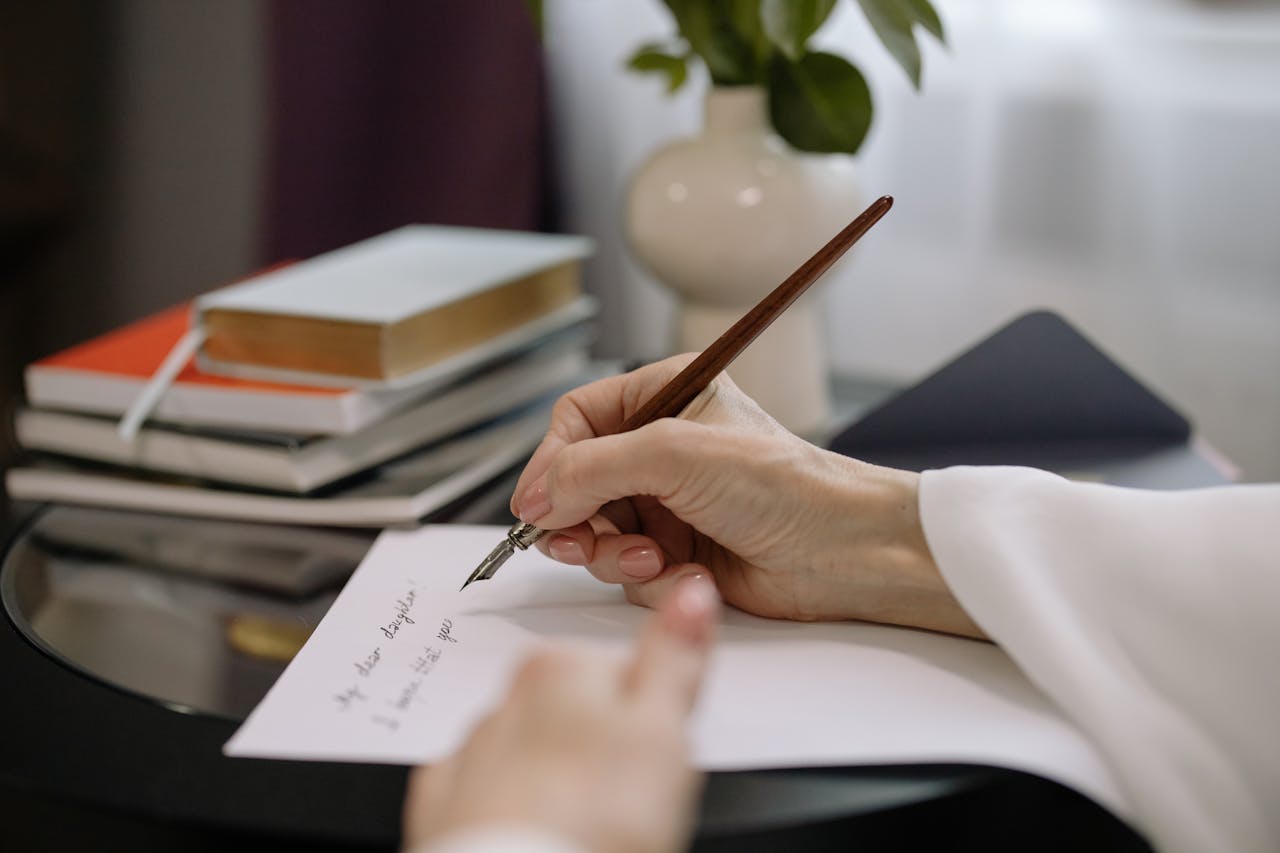
Returns Through my window, I watch a red balloon of flesh under a lizard’s neck inflate; the five-inch brown creature must want either to mate or to fight. I envy how clearly he expresses himself. I’m sitting in front of my computer, having just finished preparing my late father’s tax returns. As his next of kin, I’ve been settling his affairs—I’ve sorted, crunched, and reconciled his numbers. He died eight months ago, but for some unknown reason, stopped doing his taxes five years before. I have one more step to take: write the IRS a letter of apology. I lean forward in my chair and push my hair behind my ear.
A promising beginning. It doesn’t imply intimacy, and it doesn’t show fear.
Good grief. The government doesn’t want my irresolution.
I take my hands off the keyboard. On the backs of my wrists, small beads of sweat begin to appear. It’s a sticky Florida night.
~
During a Thanksgiving, my father made a confession to my aunt. The two of them weren’t close—he could be difficult. Still, she continued to invite him for holidays, and sometimes he went. While her three grown sons and their families cheered a TV football game in the next room, he whispered to her that he hadn’t done his income taxes in a very long time. She’d asked him why not, but he’d bypassed the question, wanting to know instead if she thought the government would come after him. For him, life was a series of conspiracies. My aunt told me this story at Lamberti’s, where she’d invited me for lunch. My family believed that all big events should be marked with fancy restaurant meals; rites of passage warrant heavy napkins. Recently, my father had gone insane. In his room at the hospital, he was shivering beneath a bathrobe and speaking in babble. I was twenty-five, and this was the first time I had seen his manic depression up close. My aunt seemed to think I should learn the specifics of his chaos—I couldn’t stay protected forever. She twisted a pepper grinder over her pasta, frowned at it, and then turned it upside down to peer at its innards. “Your father’s a mess,” she said, plunking the grinder down on the table. “He doesn’t understand that he lives in the world with the rest of us.” She signaled the waiter and ordered a third glass of wine. I knew I was supposed to defend him, but years of conflict and estrangement held my tongue. I sipped my Pellegrino. From our table, I could see the gleaming top edge of the Garden State Racetrack. My father loved the rush of gambling, his single vice. I remembered how when I was younger, he used to take me to the track with him. I was his lucky rabbit’s foot, he would say, squeezing my hand. I liked going because I liked anything that brought him pleasure. He had a way of drawing others into his emotions. No one under twelve years old was allowed at the track, so on the days we went, my dad advised me ahead of time to try to look “mature.” Once, when I was eleven, I’d consulted with my girlfriend up the street: should I or shouldn’t I stuff my bra? We decided the risk wouldn’t be worth the potential embarrassment of getting caught. Back at my mother’s apartment, I selected the dangliest pair of earrings from her jewelry box. I slipped them into my ears, admiring how their metallic circles shone in the bathroom’s fluorescent light. Leaning over the sink, I used a sponge to spread liquid foundation over my skin. I drew lines under my eyes at a turtle’s pace. I dusted blush a few shades too deep on to my cheeks, and I uncapped a tube of lipstick and pressed the rounded cone to my lips. I read the label for the name of it: Chinchilla. When I stepped back to study my reflection, I saw eyes etched in black and a face tinted with rose. “You make a lovely ingénue, my dear,” my dad said when he picked me up. I smiled shyly at him. He looked in the car’s rearview mirror and patted down some of the errant brown hairs he’d combed over his bald spot. I sometimes thought the comb-over was silly, but other times I liked it. It made him look like a kooky professor, someone beyond the cares of everyday life. We stopped at a bank. In the lobby, my dad saw someone taking a long time at the ATM, and he said, laughing, “Look at that poor, broke bastard! How many times is he going to hit those buttons? He can’t make money come out if it isn’t there. Will it magically appear? What a sad sack!” When he pulled his own ATM card from his pants pocket, some dirty pennies fell out, too; they bounced on the bank’s thick carpet. I helped him to pick them up. Occasionally, I saw my schoolmates at the track. I never asked anyone, but I thought I saw extra eye shadow on some of them. We would swing on the chrome railings in the Bettor’s Lounge and eat half-stale soft pretzels coated in mustard while our fathers studied the racing forms. My dad would let me place the bets with the man at the window, having taught me about win, place, and show. “Come on!” he would cheer as packs of lean, shiny horses thundered toward the finish line. He would only play a few dollars at a time, so he didn’t seem to mind losing. We would stay for about two hours, and when we left, his mood would be the same as when we arrived, maybe a little calmer. On the ride home, we would sit in contented silence. At Lamberti’s, I told my aunt that my father was on a new medicine, hoping I sounded upbeat. “Oh, that’s good,” she said. She had the look of someone who wished she hadn’t told one spouse about the other’s cheating. “Who knows, maybe he’ll do something about the taxes. I just thought I should tell you.” The waiter brought her new wine glass, and she thanked him with a stiff grin. It was two years before my father’s sudden, fatal heart attack.
~
My father’s death left me with a heap of unanswered questions. He and I had talked about his illness only a few times—he was ashamed of it, and I was squeamish about bringing it up. I’d been moving unescorted through memories, trying to understand how great a force the disease had been in our lives. I wasn’t an expert, but I knew that mood disorders were a slippery business; the barrier between the condition and the person was porous. Any revision of the past I made now would have to go without a crucial editor. Meanwhile, I had moved to South Florida for graduate school. I lived in a townhouse, and its marble floors were cold and hard on my feet. It was the rainy season, so water poured from a black sky in the afternoons, and thunder jostled the furniture. After the storms, the grass glowed phosphorescent. The bougainvillea flowers spilling from my neighbor’s gate glittered like amethysts. Short white birds with long beaks sucked the ground for worms. I stopped wearing shoes that couldn’t handle mud and dresses that couldn’t take a soaking. I was reading Ann Radcliffe’s Gothic novel, The Romance of the Forest. I liked the picture on the cover, which depicted a tall, vined tree twisting up to the sky. At the start, Adeline, the young heroine, has escaped the convent where her guardian sent her against her will. She finds herself in an old, abandoned abbey in a forest. A ghost lives in the abbey, and he moans at night. Adeline thinks she sees his shadow, but she’s never sure. The forest’s land belongs to a Marquis, an oily, perfidious man. When he discovers Adeline, he kidnaps her and whisks her off to his chateau. He doesn’t manage this, however, before Adeline has found in the abbey a decaying, faded scroll. The writing on it describes the last days of the author's life before his murder at the hands of villainous kidnappers. Adeline feels mysteriously drawn to the scroll and keeps it with her. I had my own weird papers to decipher. Once my first wave of grief passed, I started working on my father’s estate. “Estate” was the court’s word, and it sounded strange; we weren’t estate people. To confirm what my aunt had told me, I wrote to the IRS—could I please have a transcript of my father’s income tax returns for the last ten years? They responded immediately, the letter arriving in a discrete white envelope. It used a blockish, all-capital font, and its logo graced the first page: an abstract-looking American eagle with scales of justice for talons. Its language wasn’t punitive; it stated simple facts. The Internal Revenue Service had no returns on file for Richard C. Smith for tax years 1996, 1997, 1998, 1999, and 2000. I paced the room and listened to the rain thrum on the roof. I made an appointment with a lawyer. When we met, I liked his no-nonsense manner; we talked about my dead father as though he were a shower curtain. Still, the man’s eyebrows fluttered when I admitted how many returns were missing. He said I had to file them; it was illegal not to. I brooded—clearly, my dad had shirked his civic obligation with me in mind. He provoked me even from the grave. Then the lawyer mentioned the letter, and at first, I misunderstood. Miffed, I asked what on earth I had to apologize for. With a look that suggested reined-in condescension, he explained I should apologize on my father’s behalf. The letter should say that I regretted my father’s delinquency, that I took responsibility for his mistakes, and that I hoped these late returns would restore him to positive standing. I listened to him carefully and tried to ignore the chipmunk screaming in my head there was no way I could do this. The IRS was invisible, specter-like, all-powerful. Who knew what havoc it could wreak, what tribute it might exact.
~
Despite the cheesy plot, I loved The Romance of the Forest from the beginning. Gentle, yet daring Adeline is unprepared for the world’s savagery. My professor linked the novel with Sade’s Justine; in both stories, brilliant, brutal, older men victimize pretty girls who respond with appealing cries of misery. In one passage, the Marquis has locked Adeline in her sleeping chambers. Knowing he will return for her soon, she crawls out of a window. She stumbles through a thorny wood, her porcelain chest heaving and her velvet cape catching brambles. Along the shore of a lake, she trips over gnarled tree roots while moonlight shines on her tearstained face. I thought of her plight when I looked over the first blank 1040 for my father. I’d never noticed before how Box 6A prompts a person to acknowledge vulnerability: “If someone can claim you as a dependent, do not check box.” 6A gets you to think of yourself in relation to others, to concede whether anyone else can hold sway over you.
~
On a Friday night, when I was seven, my father took me to a diner. It was shortly after his divorce from my mother. When the bill came, he slapped some cash on the table. He was grumpy that night, and cold to me in general—I wasn’t always sure he liked me. He had insisted on visitation rights, but most of the time when I stayed with him, he remained in his room. When he remembered I was there, he told me my mother was a slut, sometimes crying or yelling it. His temper was epic; he experienced anger with an intensity I’d never seen in anyone else. Things were better if I could get him to laugh, so I tried to do that a lot. I became a comedienne: when I “killed,” all was well, but not so when I “bombed.” That night at the restaurant, my jokes about the gummy consistency of my hamburger’s cheese and how another customer sneezed like an elephant (his head swung upwards like a trunk) had fallen flat. I wasn’t ready to give up. “Wow, big tip, Dad,” I jeered as I followed him to the exit. My taunt was meaningless: I had no idea what the meal cost and only a loose understanding of what a tip was. My father whipped his body around, and his gas-flame eyes flashed. He quickened his pace; I had to rush to keep up. In the parking lot, he grabbed my forearm. “If you ever say anything like that to me again,” he said in a low voice, “I will drive you out to the turnpike and leave you there. Do you understand?” I nodded. “Get in the car.” He dropped my arm and shoved me into the passenger seat. His big gut pressed against the steering wheel as he drove. When he turned, the wheel clicked against his shirt buttons. He slowed at stop signs but didn’t stop. I saw we were heading towards the turnpike and bit my lip to keep from crying. He took the onramp. I gripped the shoulder strap of my seatbelt, wondering what it would feel like to jump out of a moving car. After a few miles, he pulled in to a rest stop. The lights were out, and corded payphones dangled free from their hooks. He turned off the engine. “I’m sorry,” I whispered. He stared at me, and I felt the hole where I thought his love for me should be. Then, without a word, he restarted the car and turned it around. I rested my head against the window. There was no way for me to understand what had happened, and the same was probably true for him.
~
I combed the Internet for information about decedents and debts. Why hadn’t my father filed? If he had been an embezzler or a cheat, would I be held responsible? Stark words like “garnish,” “penalty,” and “malfeasance” littered the computer screen. I clicked through dozens of search results, hoping that if I looked hard enough, I might find a page that mirrored my situation exactly. The best I could come up with was a form on the IRS website, whose suite of pdfs was eerily bountiful. Form 56 would allow me to declare a “fiduciary relationship” with my father. The idea bugged me. I didn’t want to declare any relationship. I called my lawyer to ask if I should fill out Form 56. He didn’t know what I was talking about, so I pointed him to the URL and peppered him with questions about the length and firmness of fiduciary ties. He was quiet for a couple of minutes, and then he advised me to go ahead with the 1040s as we’d discussed. I had put all the papers for my father’s estate in a file box I kept in my office. Tracing his money meant tracing his choices—it would reveal his mental solvency. I was wound up about doing this. Wound up and black around the heart. For a few weeks, I sifted, and I found a few envelopes with “Important Tax Information” stamped on the front; did he intend to file eventually? The Thanksgiving he confessed, was he asking my aunt for help? I gave each tax year a folder, and I started an Excel spreadsheet to track where I needed to call. A lower-case x in a cell meant that I had the right information. The sheet’s cool green rectangles soothed me. I put the papers in loose piles on the floor and left them there. One morning, I dug through them, and my hand touched something bumpy. I looked down to see a dead, semi-flat lizard. I caught a glimpse of its vertebrae and its tiny closed eyes. House lizards liked to burrow, and this one must have gotten stuck. I shrieked and flushed the corpse down the toilet.
~
Right after my father died, I had gone to his house. I’d dreaded the trip; I hadn’t been there in several years. The idea of visiting where he, and we, used to live, and where he had taken his final breath, felt like stepping into a swamp. When I arrived, I found it in worse shape than I had anticipated. Mold grew on the walls of the basement. Stacks of pizza boxes made towers in the living room, and cartons of lice poison and rolls of aluminum foil covered the kitchen table. Piles of torn, dirty clothes obscured the bureau in the master bedroom. The seventies modern art paintings I remembered still hung on the walls, but most were crooked. I had contacted a company that emptied personal residencies; they would take some items to charities and send everything else to the dump, but they hadn’t come yet. I felt bad about not keeping more of my father’s things, but the impulse to erase was strong. Ironically, he had given me the name of the disposal company—he’d left their flier on the coffee table. I could picture him sitting bleary-eyed on the couch, absorbing the mess. On a ledge in the den, I spotted my old toy blue piano, the one with the plastic multicolored keys. Although my father cringed at noise, he’d never tired of hearing me play it. I picked up the piano and shook it—the orange key still didn’t work. I pried it free and stuck it in my pocket. Why not, I thought. I would rather enshrine this than a dirty shirt or a roll of tin foil. Horrible and hysterical, the foil boxes lay on the table like bars of gold. So, Dad, you really were a member of the Tinfoil Hat Club! After that, I started grabbing pieces of paper with numbers on them. Later, I wished I had stayed longer and taken more, but just then, I had to control how much I took with me and how much I left behind. Full knowledge of his suffering, I feared, would pull me down with him.
~
At first, the nasty, paternal Marquis wants Adeline as his concubine. When he learns more about her, he resolves she must die instead; there’s a slim chance he’s her biological father. As I read this part of the story, I guessed Radcliffe knew that along with her skeletons and castles, she could boost her sales by adding some mild incest. When I was seventeen, my dad and I went to Las Vegas. This was before Vegas reinvented itself as a family destination—then, its main charms were bright lights and seediness. We stayed at the Excalibur hotel, a whipped cream fortress with magenta and turquoise turrets. I had my own room with a view of the Strip. The free breakfast buffet offered a pancake station with a punch bowl of topaz syrup. During the day, my dad gambled while I swam in the pool’s jello-y water. One afternoon, we went to the early bird Folies Bergère show at the Tropicana. We sat at a banquette near the back, and the hostess drew the table close to me in order to accommodate my dad’s bass drum stomach. Topless women with pointy headpieces waltzed across the stage, leading my dad to comment that those hats must make great battering rams. As their long legs waved in the air, he lectured on French cabaret history. Afterwards, we took a cab ride of the Strip, and I said Las Vegas was synthetic heaven. He said yes, that was exactly what it was, sounding thrilled I’d made this observation. On our last night, I walked around the hotel while he went down to the casino. I wore a purple dress maybe a quarter-inch longer than the skirts of the cocktail waitresses selling cigars and glow sticks. It had a silver thread running through it. I passed through an empty conference area; the ballrooms were all locked. A tall, older man in a striped suit bumped into me. He wore a plastic nametag on a string around his neck, but I couldn’t read it. He said hello to me and I to him. I didn’t want to be rude, so I stood there. “That’s a nice dress,” he said, and I thanked him. His eyes were glassy, his smile dippy. He continued to look at the dress. He seemed to be struggling with what to say next, so I started to walk away. Instead of speaking, he reached out a hand and brushed my waist. I quickened my step and acted as though nothing had happened. When I turned back to look at him, he was slumped against the wall. I met my dad in front of the gift shop. “I won,” he said. He was glowing. “That’s great,” I said. We rode the elevator up to our rooms.
~
I read my dad’s bank statements, his mortgage coupon book, and a handful of incomplete credit card applications. I studied his trapezoidal blue scrawl on scraps of yellow legal paper. Sometimes letters, sometimes numbers, sometimes neither. He had been late paying almost everyone. I found delinquency notices with the tops of their pages lined in red. His water and cable had been shut off regularly, and the City of Woodbury had let him know he had to pay for leaf removal like every other citizen. At one point, he’d been twenty thousand dollars in debt, a big amount for someone who only made forty-five thousand a year. Some of the papers were crumpled as though he’d balled them up in his fists. What had he done when collection agencies called, as they must have? He might have hurled obscenities at them and hung up; during my early twenties, he’d hung up on me so many times I thought of the clacking sound as one of his phonemes. I saw scattered, handwritten records of ATM withdrawals, and they revealed a pattern: consistent tallies and amounts for a few weeks, then a gap of a month, and then only random entries. There was no continuity from one record to another, making me think he had started and stopped this project many times. I opened a partially used book of checks. I saw that he had signed each remaining one; the tail of his cursive R was wobbly. I tried to imagine why he would’ve done this, and with queasiness, I realized he must have worried he wouldn’t be able to make his signature someday. His hands shook because of his medication. I closed the book fast. Over the years, he had owned shares in dozens of mutual funds, and I had to get a 1099 for each. I learned through phone calls that some of them didn’t exist anymore. “Yes, this is his daughter,” I kept affirming disembodied voices. “Yes, I’ll hold.” I knew his problems weren’t unique. I’d read about how when bipolar people were manic, they could be irrational with money. Their depression might not lift long enough to balance a checkbook. The Internet told me that about a quarter of the population didn’t file their tax returns, anyway. Still, I felt ashamed, and my body grew heavy as I assumed the weight of his mistakes. Going through the papers, I discovered I’d collected some dross: utility statements, monthly pay stubs, gas bills. I came across a receipt from the women’s accessory department at Macy’s. It was for the dress scarf he’d given me two birthdays ago. He’d loved to give gifts, but he was bad at selecting them. Since my college graduation, he’d gotten me imitation pearl earrings, a women’s raincoat from London Fog, and a man’s briefcase. A secretary in a fifties steno pool would have loved the earrings. A forty-year-old woman executive would have gotten a lot of wear out of the raincoat. And the briefcase resembled one he used to carry. The nylon scarf had dainty pink rosebuds on it. It was too feminine, but I’d thanked him profusely. By this time, he’d grown frailer to me—he’d been on lithium for more than twenty years. Lithium is a slow-acting poison, and it wears on you; it makes you listless and overweight, and your gait slows. You become more prone to heart disease. I tied the scarf around the handle of my suitcase so that I could find it circling on airport baggage carousels. I grew fond of it, this little splash of pink appearing in the gray of foreign terminals.
~
As Gothic convention dictates, Adeline has disturbing dreams. In one, a man in a sable cloak leads her down a winding staircase. In another, she sees a man lying in a coffin. She senses he’s a relative of hers, but she doesn’t recognize him. Blood gushes from his side, and some of it splatters on her face. Soon, the whole room fills with his blood. Some readers believe this image suggests castration or menstruation, but I think Radcliffe meant to show how family and heritage submerge us all. This is what I want to think, anyway. I dreamed about my father a lot the first year he was gone. In one, he and I were at a party at my mother’s house. Nobody spoke to him. At first, this didn’t seem unusual; this is how it was in life. Gradually, I realized that no one else could see him, that I was sitting next to his ghost. “Do you know you’re dead?” I asked him. He looked at me with affection. “What do you think?” he asked dryly, but not without encouragement. I was disappointed when the dream ended. In another, I was driving in a forest. I traveled over rocky roads and through scraggly patches of trees, feeling tense and harried. My dead dad was sitting next to me in the passenger seat. He didn’t move, and it wasn’t clear he was sentient. His body was made of pebbles. As I rounded a steep curve, the mass of him made a rumbling sound. I was searching for somewhere to dump him out. On one of the last nights I saw him, we met for dinner, and close to the end of the meal, he pulled out his cracked leather wallet. I reached for my purse, determined not to let him pick up the check. With no ceremony, he handed me five twenty-dollar bills. “Spend it on something frivolous,” he instructed. Dumbfounded, I thanked him. After a few minutes, he said, “I’ve been a good father tonight. I took you out to dinner, and I gave you some money.” He smiled weakly at me. I noticed how the bags under his eyes had thickened while the rest of his face had thinned—he was losing muscle mass. I folded the money, which was still warm from his grasp. I told him he was generous.
~
The Marquis turns out to be mistaken. Adeline’s true father was a wealthy, gentle nobleman whom she’s never met. Miraculously, he’s also the author of the scroll. The coincidence! At the end of the book, all is as it should be: Adeline becomes an heiress and acquires a nice husband, and the Marquis poisons himself. To honor her unknown, dead, good father, she keeps the scroll. Its repeated lament—“Oh, my children”—has assumed new significance. “Romance” didn’t always mean love story. It used to mean story in general, usually a fantastic one. One doesn’t read a romance for psychological realism; what is jagged off the page is smoothened upon it. In Adeline’s Romance, it makes sense for her to have two “fathers”: the Marquis―the living, bad, pseudo one who pursues her and wants to hurt her, and the dead, good, real one she never meets but who gives her a fortune. It’s neater for Radcliffe to split these traits between two people instead of trying to house them within one. When I teach, I try to get my students to embrace ambiguity in books, to feel how satisfying it is to accept more than one interpretation or answer. I don’t tell them that, embarrassingly, I don’t like ambiguity in my life much, and that certain people seem to cry out for me to understand them in one way and no more. Your dad was ambiguous enough while he lived, whispers a dust mite in my psyche. Now that he’s dead, let’s make him as simple as possible.
~
It’s late, and I’m still sitting at my desk. Why is this letter so tricky? All I have to do is apologize to the IRS for my father’s failure to meet his obligations. I can write, “I’m sorry,” and that will be that. Slowly, I begin to type.
With relief, I tap the final period. I hadn’t been able to see before that a story of discovery was in order. The parent has revealed his secret; the child has learned the truth. My dad’s illness was all that kept him from fulfilling his duties. Such contrivance beats back any sneaky double meaning, and even better, it allows my dad and me to join a classic literary tradition: a previously hidden craziness or crazy person appears on the scene at the last minute to clear everything up. The next day, I print out copies of the letter to include with the returns. I sign my name on each letter and in the five boxes designated for the taxpayer’s signature. At the post office, I send the returns certified mail. I hold the stamped confirmation slips in my hands as I leave. On the way home, I buy a guava turnover and a Cuban coffee. At home, I sit on my patio under the hibiscus tree. The sun shines yellow-bright. I take out one of the confirmation slips and scan it for the delivery date. Some guava syrup gets on it and leaves a pink fingerprint. The taxes are official now, I think. They bear the sacred seal of pastry. In a few weeks, my own handwriting stares up at me from the mail pile: the certified return postcards. Addressed to me by me, they suggest that what I can do about my father now is tell myself stories. As far as I can tell, he owes the IRS nothing. Still, I await notification that he’s earned outrageous penalties, swindled the government out of thousands of dollars. I brace for the arrival of a new white envelope. None comes.
Lauren Smith's writing has appeared or is forthcoming in New Madrid, The Writer’s Chronicle, and The Toledo City Paper. She's taught writing and literature at Simmons College, the University of Miami, and the University of Toledo. She recently contributed to the Bread Loaf Writers’ Conference and is pursuing an MFA in nonfiction at Bennington College.
© 2009-2010 prickofthespindle.com |
||
|